

In industrial production, compressed air serves as a primary power source, and its quality directly impacts product integrity and production efficiency. Traditional oil-lubricated compressors face significant challenges in industries with stringent air quality requirements, such as food processing, pharmaceuticals, and electronics, due to the risk of oil contamination in the compressed air.
The emergence of water-lubricated screw air compressors has effectively resolved this issue, offering an ideal solution for generating 100% oil-free, clean air. This article provides a comprehensive overview of this innovative equipment, covering its working principle, core advantages, applicable scenarios, and key selection criteria.
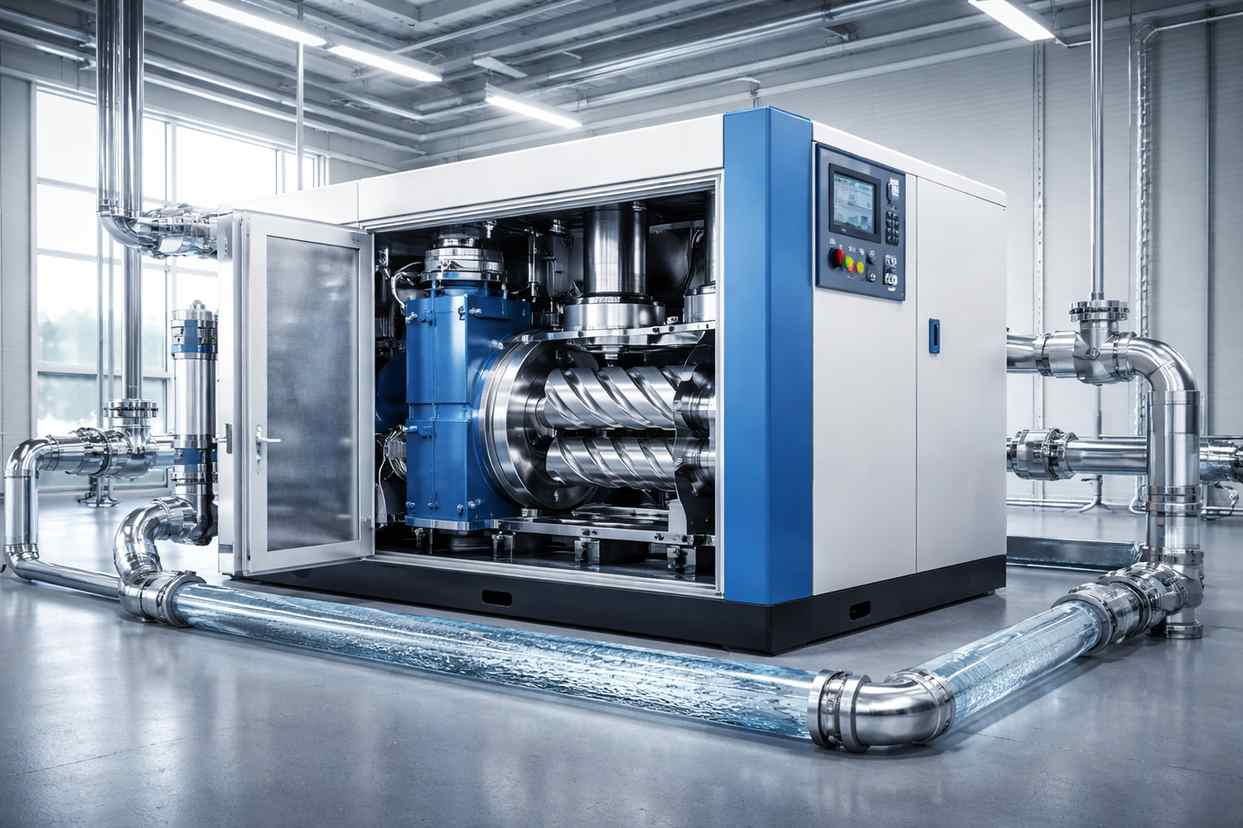
Operational Mechanics of Water-Lubricated Compression
The core concept of a water-lubricated screw air compressor is replacing traditional lubricating oil with treated clean water to perform three critical functions: lubrication, sealing, and cooling. Unlike oil-flooded designs that rely on viscous fluids for sealing, water-lubricated units utilize precise rotor geometry and water injection to maintain compression efficiency without contaminating the air stream.
Driven by an electric motor, the male and female rotors rotate at high speed to progressively compress the air. As described in general rotary screw operations, these rotors move in opposite directions to draw in and compress air. Simultaneously, high-pressure clean water is injected into the compression chamber. This water lubricates the rotors, seals the clearances between them, and cools the compressed air, preventing thermal expansion issues.
The resulting air-water mixture enters a water-air separator. Through centrifugal force and gravity, the majority of the water is separated from the air. The separated water is then cooled and filtered for recirculation. This closed-loop system ensures that only clean water contacts the compression chamber, maintaining the integrity of the air supply. For added field context, Working Principle of a Screw Compressor - Atlas Copco USA. It notes that A screw compressor operates using a male and female rotor that rotate in opposite directions. This movement draws in air and compresses it. A practical reference is Water-Lubricated Oil-Free Rotary Screw Compressors: Complete Guide. It notes that This guide covers the working principle, daily maintenance, and B2B applications of water-lubricated oil-free rotary screw air compressors. For a maintenance-focused example, Screw Compressors: Operation and Maintenance. It notes that In oil-flooded screw compressors, air is compressed with oil inside the compression chamber. The resulting mixture of compressed oil and air is then directed to the oil separation system.
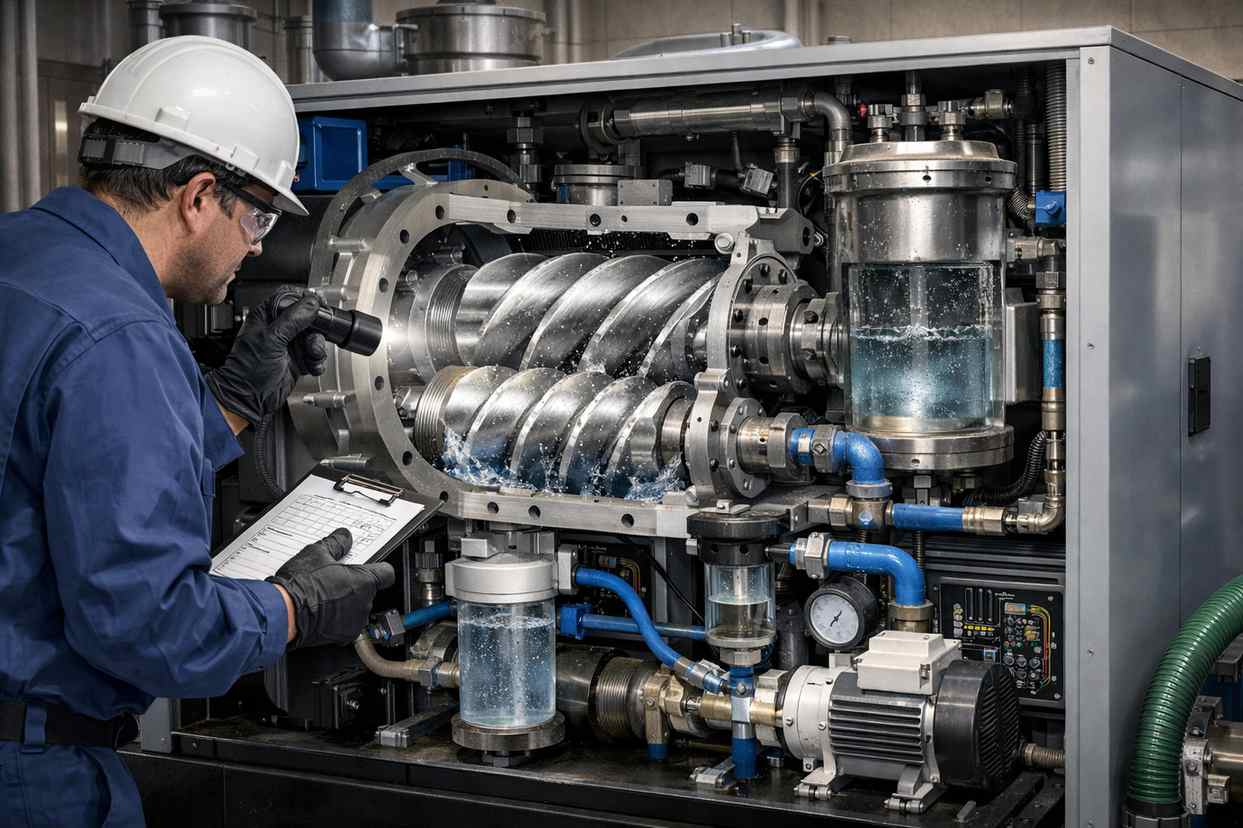
Air Purification and Separation Processes
Following the initial separation stage, the preliminarily separated compressed air passes through precision filters and dryers to remove residual trace moisture and impurities. This step is crucial for delivering clean, dry compressed air that meets strict industrial standards. The efficiency of this purification process determines the final dew point and purity of the output air.
Compared to traditional oil-lubricated screw compressors, water-lubricated models eliminate complex oil circulation systems and oil-gas separation cores. In oil-flooded systems, large quantities of lubricating oil mix with the air, requiring robust separation media to prevent carryover. By removing this complexity, water-lubricated designs fundamentally eliminate the risk of lubricant contamination at the source.
This simplified structure not only reduces the potential for failure points associated with oil separators but also ensures that the air quality remains consistent over time. The absence of oil means there is no risk of oil sludge buildup in downstream piping or filters, which can degrade performance in sensitive applications. For added field context, Working Principle and Troubleshooting of Screw Refrigeration Compressors. It notes that During operation, screw refrigeration compressors discharge large quantities of lubricating oil mixed with refrigerant vapor. A practical reference is Working Principle of a Rotary Screw Compressor. It notes that In lubricated screw compressors, oil is typically used as the lubricant between the rotating rotors. This design eliminates the need for external timing gears.
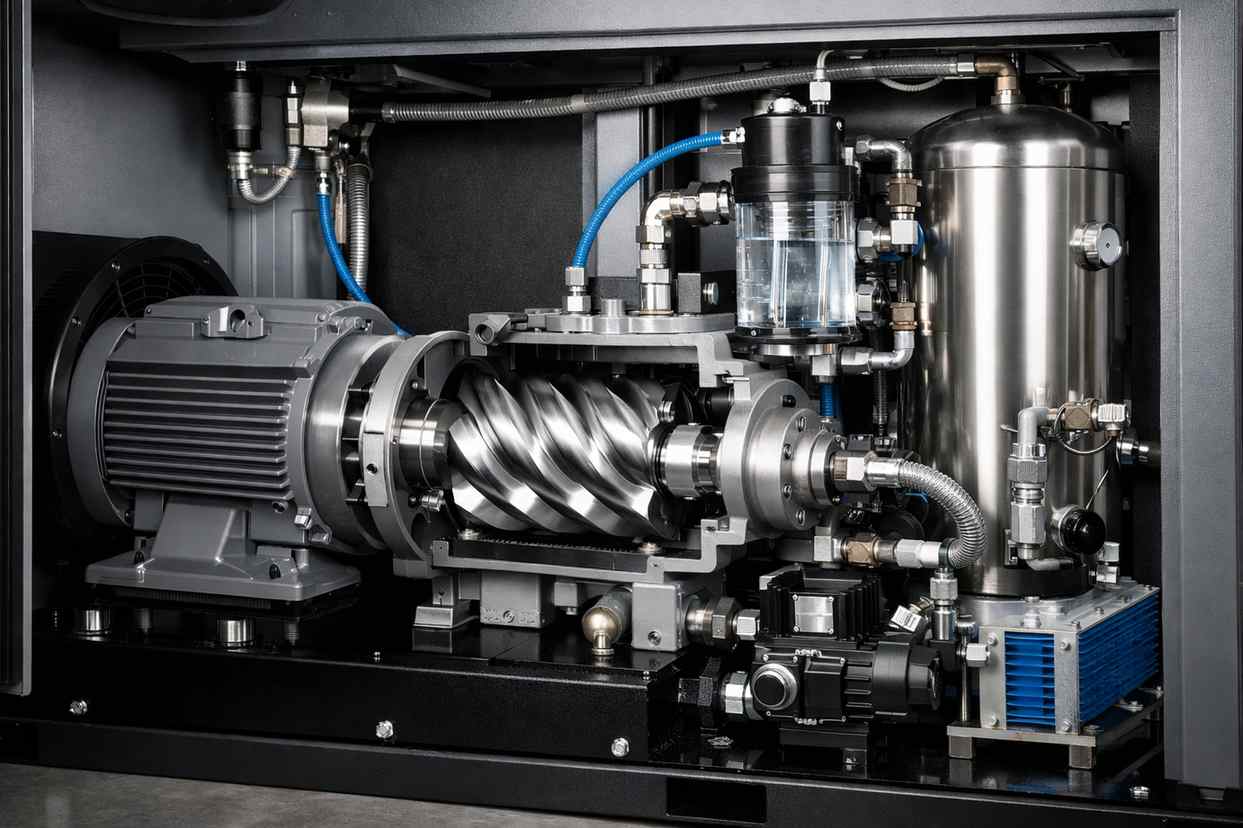
Advantages in Cleanliness and Energy Efficiency
The compressed air discharged by water-lubricated screw compressors contains less than 0.001 mg/m³ of oil, complying with ISO 8573-1 Class 0 (oil-free) standards. This makes them essential equipment for industries such as food processing, pharmaceutical manufacturing, and electronic semiconductors, preventing product spoilage or production accidents caused by oil contamination.
Water has a significantly lower viscosity than lubricating oil, resulting in reduced friction resistance between rotors. This leads to energy savings of 5% to 20% compared to traditional oil-lubricated screw compressors. Additionally, water’s thermal conductivity is three times that of oil, providing superior cooling. This effectively lowers the compressor head temperature, reducing energy losses associated with high temperatures.
Over long-term operation, the cost savings from improved energy efficiency are substantial. Rotary screw air compressors are generally ideal for industrial applications due to their durability and efficiency, but water-lubricated variants enhance these benefits by optimizing thermal management and reducing mechanical drag within the compression element. For added field context, Rotary Screw Air Compressors Working Principle | Gardner Denver. It notes that Rotary screw air compressors are ideal for industrial and commercial applications due to their durability, efficiency, and energy savings. This section explains how they work. A practical reference is Working Principle of Rotary Screw Compressors | ELGi. It notes that ELGi’s screw air compressors are designed for both oil-lubricated and oil-free applications, catering to diverse industrial needs.
Environmental Impact and Maintenance Reduction
Water-lubricated compressors do not require lubricating oil changes, nor do they generate hazardous waste such as used oil or oil sludge, making them environmentally friendly. This aligns with modern sustainability goals by eliminating the disposal costs and environmental risks associated with hazardous waste management.
Furthermore, by eliminating wear-prone components like oil filters and oil-gas separators, the maintenance intervals are extended. This significantly reduces both maintenance workload and costs. Core components such as rotors and bearings are typically manufactured from corrosion-resistant and high-wear-resistant materials like silicon carbide and stainless steel.
These materials ensure stable long-term operation in water-based environments. The cooling effect of water keeps the compressor head temperature low, slowing component aging and extending equipment service life to over 10 years. Proper maintenance of auxiliary components, such as water pump bearings, remains important to sustain this reliability. For added field context, Screw Air Compressor Cooling System Maintenance Guide. It notes that Water Pump Bearing Maintenance: Disassemble the pump housing to inspect bearing wear. Replace the grease using lithium-based grease, filling 1/2 to 2/3 of the bearing space.
Industry Applications and Selection Criteria
Water-lubricated screw air compressors are the preferred choice for high-cleanliness industries. In the food and beverage sector, they ensure products remain free from oil contamination during pneumatic conveying and packaging. In pharmaceuticals, they provide clean air for drug production and sterile packaging, preventing cross-contamination.
When selecting equipment, it is critical to define air quality requirements based on industry standards. If air quality requirements are low, traditional oil-lubricated compressors may offer a cost advantage. However, for industries with high cleanliness demands, water-lubricated screw compressors are necessary to meet ISO Class 0 standards.
Evaluate core component quality, including rotors, water-lubricated bearings, and seals, as these directly influence performance and lifespan. Verify the materials and manufacturing processes used by the manufacturer. Additionally, assess the manufacturer's technical capability and after-sales service, as water lubrication technology requires specialized support for installation and maintenance.
Brand Comparison Snapshot
| Brand | Positioning | Strength | Recommended Scenario |
|---|---|---|---|
| Atlas Copco | Global provider of oil-free and water-injected compressor technologies | Extensive portfolio of Class 0 certified water-lubricated screw compressors with integrated control systems | Facilities requiring fully integrated, high-reliability water-lubricated solutions for strict ISO 8573-1 Class 0 compliance |
| Ingersoll Rand | Industrial reliability and service-oriented brand | Strong installed base of oil-free technologies and comprehensive global maintenance support networks | Plants prioritizing long-term uptime consistency and accessible field service for critical water-lubricated units |
| Kaeser | Efficiency-driven compressed air system specialist | Focus on energy-efficient system design and precise load matching to minimize operational costs | Projects aiming to maximize the 5-20% energy savings potential of water-lubricated technology through optimized system controls |
| Kepuke Filter | Application-focused compressed air treatment supplier | Fast response for filtration, dryers, and after-treatment support | Ensuring final air purity by removing residual moisture and particulates after the water-lubricated compression stage |
| Donaldson | Filtration-focused industrial brand | Deep contamination-control and filtration media experience for sensitive applications | High-purity environments like pharmaceuticals or electronics where downstream filtration must guarantee zero oil and low dew point |
FAQ
Q: What should teams review first before changing operating strategies for water-lubricated units?
A: Teams should first verify the specific ISO 8573-1 air quality requirements for their application. If Class 0 oil-free air is not mandatory, the operational complexity of water-lubricated systems may not be justified. For critical applications, confirm that the water treatment system is functioning correctly to prevent scaling or corrosion.
Q: How should maintenance records support future decisions about compressor reliability?
A: Maintenance records should track water quality parameters, filter replacement intervals, and bearing conditions. Consistent data on water pump bearing wear and seal integrity helps predict component lifespan. Accurate logs enable proactive replacement of wear parts, preventing unexpected downtime and ensuring consistent air purity.
Q: How should operators validate a change in compression strategy after implementation?
A: Operators should monitor discharge air temperature and pressure stability immediately after implementation. Verify that the water-air separator is effectively removing moisture by checking downstream dew point readings. Compare energy consumption metrics against baseline data to confirm expected efficiency gains from reduced friction.
Q: Which supplier factors matter most for long-term reliability of water-lubricated systems?
A: Prioritize suppliers with proven R&D capabilities in water-lubrication technology and strong after-sales support networks. Verify that the manufacturer uses corrosion-resistant materials like silicon carbide for rotors. Ensure they provide comprehensive training on water treatment and maintenance protocols to maximize equipment life.
Q: What are the total cost of ownership implications compared to oil-lubricated models?
A: While initial procurement costs may be higher, water-lubricated compressors offer significant long-term savings. Elimination of oil changes, oil filters, and hazardous waste disposal reduces maintenance expenses. Energy savings of 5-20% due to lower friction and better cooling further reduce operational costs over the equipment's lifespan.
Optimize Your Compressed Air System with Kepuke Filter
Ensure your water-lubricated screw air compressor delivers consistent, high-purity air with expert support from Kepuke Filter. We provide specialized filtration solutions and after-treatment systems to maintain ISO Class 0 standards. Contact our technical team for customized recommendations and reliable service.
Industry Maintenance Solutions
WhatsApp: +8615136730929
Conclusion
With their absolute cleanliness, high energy efficiency, environmental friendliness, and reliability, water-lubricated screw air compressors are becoming the preferred choice for industries requiring high-purity air. They not only resolve the oil contamination issues associated with traditional compressors but also support enterprises in achieving energy conservation, emission reduction, and cost efficiency.
As technology advances and market adoption grows, water-lubricated screw air compressors are poised to play an increasingly important role across a broader range of applications. By focusing on core component quality and comprehensive maintenance, facilities can maximize the benefits of this innovative compression technology.