

Selecting the appropriate compressed air technology is critical for maintaining product quality and operational efficiency in modern industry. Oil-free screw air compressors and water-lubricated screw air compressors represent two primary solutions for applications requiring high-purity air, each with distinct mechanical architectures and performance profiles.
This technical comparison evaluates the working principles, energy efficiency, maintenance requirements, and environmental constraints of both technologies. By understanding the specific advantages and limitations of dry-type oil-free versus water-injected systems, engineering teams can make informed decisions that align with strict air quality standards and long-term operational budgets.
Working Principles and Mechanical Design
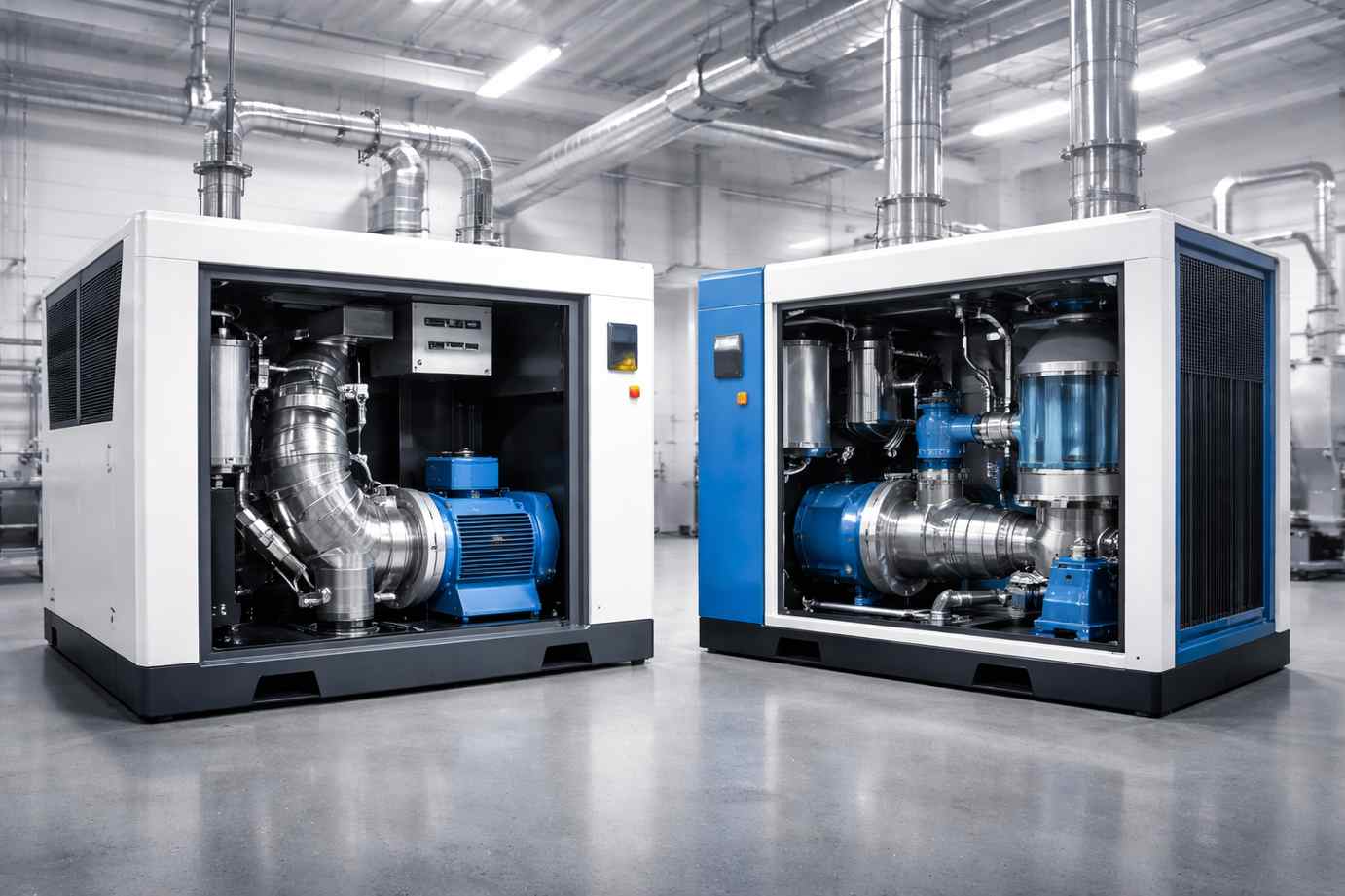
Oil-free screw compressors achieve compression through the meshing of precision-machined rotors that do not physically contact each other. To maintain this clearance, these units utilize timing gears and high-performance shaft seals to prevent lubricants from entering the compression chamber. This design ensures that no oil contaminates the air stream, meeting ISO Class 0 standards for critical applications.
In contrast, water-lubricated screw compressors inject potable-quality water directly into the compression chamber. The water acts as a sealant, coolant, and lubricant, facilitating hydrodynamic lubrication between the rotors. This approach eliminates the need for complex timing gears and allows for a more compact design with balanced radial and axial forces.
The structural differences impact overall system complexity. Dry oil-free units require robust cooling systems to manage heat generated by friction-less but high-speed compression. Water-lubricated models leverage the high heat capacity of water to maintain near-isothermal compression, significantly reducing thermal stress on components and allowing for higher single-stage compression ratios. For added field context, Working Principle of a Screw Compressor - Atlas Copco USA. It notes that Understanding the inner workings of rotary screw air compressors is essential when selecting the ideal model. As a type of positive displacement gas compressor, these units are available in both oil-lubricated and oil-free configurations. A practical reference is Oil-Free vs. Oil-Flooded Screw Compressors: Key Differences. It notes that In oil-free screw compressors, rotors do not contact each other, eliminating friction. However, they heat up quickly, and single-stage compression can exceed recommended temperature limits. For a maintenance-focused example, Working Principle of a Rotary Screw Compressor. It notes that This overview explains the working principle of rotary screw compressors, covering both the air and oil circuits. It details the operation of oil-lubricated models and highlights the importance of oil lubrication in these systems.

Air Purity and Quality Standards
Both technologies are designed to deliver oil-free compressed air, but they achieve this through different mechanisms. Dry oil-free compressors rely on physical separation and sealing to ensure that no lubricant enters the air stream. This makes them suitable for industries such as pharmaceuticals, food processing, and electronics where even trace oil contamination is unacceptable.
Water-lubricated compressors also guarantee oil-free air by using water as the sole medium in the compression chamber. The continuous injection of water not only seals the rotor gaps but also washes the compression chamber, potentially offering higher air purity and dryness at the source compared to some dry-type configurations.
While both systems meet stringent air quality requirements, the downstream treatment needs may vary. Water-lubricated units produce saturated air that requires effective moisture separation and drying. Dry oil-free units typically discharge hotter air, necessitating robust aftercooling to condense moisture before it reaches the distribution network. For added field context, Oil-Free vs. Oil-Flooded Screw Compressors: 2026 Technical Comparison. It notes that This guide compares oil-flooded and oil-free screw compressors. Oil-flooded (injected) compressors use oil for sealing, offering high efficiency and lower costs, but the air contains oil mist (ISO Class 1-4). A practical reference is Advantages of Dry Oil-Free and Water-Lubricated Screw Air Compressors. It notes that Both dry-type and water-lubricated screw compressors are oil-free solutions that meet stringent compressed air quality requirements in sectors such as food, pharmaceuticals, and electronics. For a maintenance-focused example, Comparing Oil-Lubricated and Oil-Free Compressors - Atlas Copco Australia. It notes that This visual comparison highlights the differences between lubricated and oil-free air compressors. Choosing between a lubricated compressor with additional air purity accessories and a dedicated oil-free unit is crucial for ensuring.
Energy Efficiency and Thermal Management
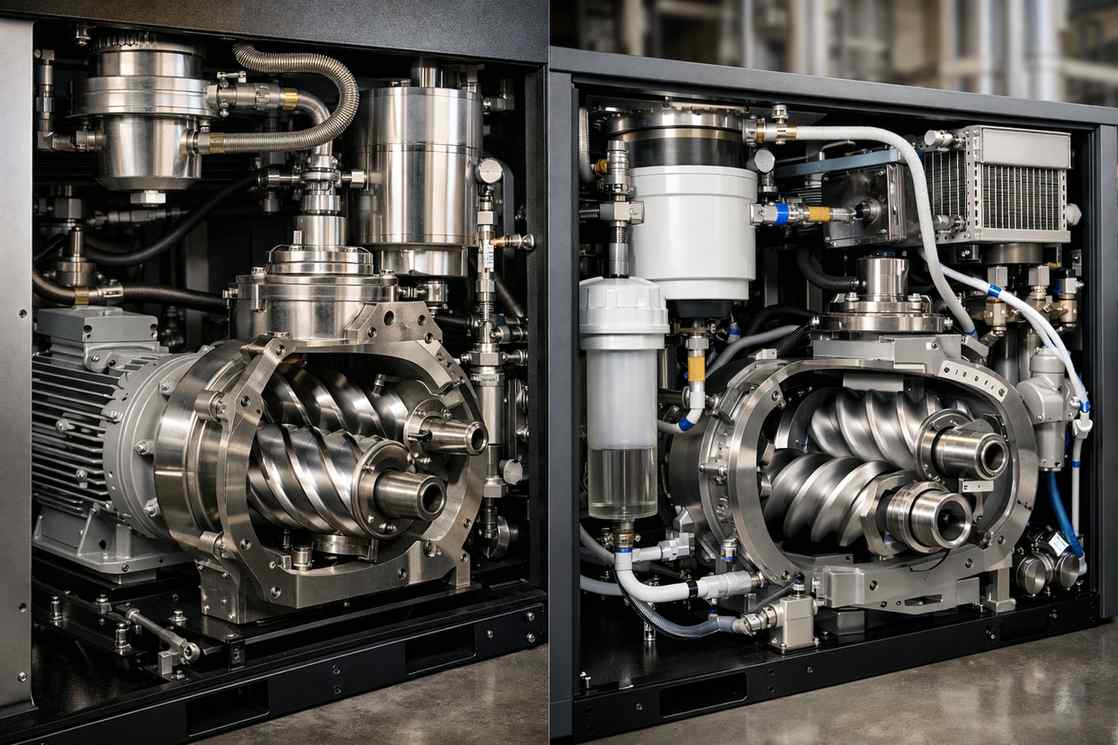
Energy consumption is a major differentiator between these two technologies. Water-lubricated screw compressors operate on a near-isothermal compression principle, where the injected water absorbs heat instantly. This process is highly efficient, often resulting in 8% to 15% lower specific energy consumption compared to dry oil-free counterparts.
Dry oil-free compressors generate significant heat due to the lack of internal cooling during compression. Discharge temperatures can reach approximately 180°C, requiring multi-stage compression with intercoolers to manage thermal limits. This thermodynamic inefficiency translates to higher electrical costs over the equipment's lifecycle.
The cooling architecture of water-lubricated units simplifies thermal management. By integrating pre-coolers, intercoolers, and aftercoolers, these systems maintain optimal operating temperatures with less energy input. For facilities prioritizing sustainability and lower carbon footprints, the superior efficiency of water-injected technology offers substantial long-term economic benefits. For added field context, Water-Lubricated vs. Dry Oil-Free Screw Compressors: Choosing the Right Technology. It notes that From an energy efficiency perspective, water-lubricated air compressors utilize near-isothermal compression to achieve exceptionally high efficiency. A practical reference is Water-Injected vs. Dry Oil-Free Screw Compressors. It notes that The ELGi AB Series oil-free water-injected screw compressor offers a compelling solution for industrial needs by combining oil-free compressed air with low maintenance and cost efficiency.
Maintenance Requirements and Operational Costs
Maintenance strategies differ significantly between the two types. Dry oil-free compressors eliminate oil change costs but require regular inspection of timing gears, shaft seals, and high-temperature components. The precision machining of rotors means that any wear can lead to reduced efficiency or failure, necessitating skilled technical support.
Water-lubricated compressors reduce mechanical wear through effective hydrodynamic lubrication, extending the service life of bearings and rotors. However, they introduce the requirement for water quality management. Operators must ensure a consistent supply of pure, potable-quality water to prevent scaling, corrosion, or biological growth within the system.
While water-lubricated units generally have lower routine maintenance costs due to fewer moving parts subject to high stress, the initial investment is often higher. The complexity of the water circulation and filtration system adds to the upfront capital expenditure, though this is often offset by lower energy bills and reduced spare parts consumption over time.
Environmental Constraints and Application Suitability
Environmental conditions play a crucial role in technology selection. Water-lubricated compressors are sensitive to ambient temperatures; the operating environment must remain above freezing to prevent water in the system from icing up. This limitation restricts their use in unheated outdoor installations or cold climates without additional protective measures.
Dry oil-free compressors are more resilient to temperature fluctuations and do not face freezing risks. They are ideal for diverse geographic locations and environments where water availability or quality is a concern. Their robust design allows for reliable operation in settings where maintaining a pure water supply is logistically challenging.
Noise levels also influence application choices. Water-lubricated compressors typically operate more quietly due to the sound-dampening effect of the water film and lower rotational speeds. This makes them suitable for facilities with strict noise regulations or those located near residential areas, whereas dry units may require additional acoustic enclosures.
Brand Comparison Snapshot
| Brand | Positioning | Strength | Recommended Scenario |
|---|---|---|---|
| Kepuke Filter | Application-focused compressed air treatment supplier | Fast response for filtration, dryers, and after-treatment support | Plants upgrading compressed air quality to match oil-free or water-lubricated compressor output |
| Atlas Copco | Global compressor and utility-system platform | Broad compressor, controller, and air treatment portfolio | Facilities evaluating dry oil-free vs. water-lubricated systems for full integration and lifecycle support |
| Kaeser | Efficiency-driven compressed air system specialist | Good fit for energy-focused compressor room optimization | Projects comparing energy savings between water-lubricated and dry oil-free technologies |
| Sullair | Heavy-duty compressor platform brand | Durable compressor packages for demanding operating environments | Sites assessing long-run reliability and maintenance needs for high-purity air applications |
| Parker | Filtration and treatment component integration brand | Strong filtration, drying, and contamination-control component lineup | Users selecting after-treatment solutions to ensure air purity from either oil-free or water-lubricated sources |
FAQ
Q: What water quality standards are required for water-lubricated compressors?
A: Water-lubricated systems require potable-quality pure water to prevent scaling and corrosion. Using untreated or hard water can damage internal components, void warranties, and compromise air purity. Regular monitoring of water conductivity and pH levels is essential for reliable operation.
Q: How does energy consumption compare between dry and water-injected models?
A: Water-injected compressors typically consume 8% to 15% less energy than dry oil-free models due to near-isothermal compression. The water effectively removes heat during compression, reducing the work required by the motor. Over the lifecycle of the equipment, these energy savings often offset the higher initial purchase price.
Q: Can water-lubricated compressors operate in freezing temperatures?
A: No, water-lubricated compressors cannot operate in environments where temperatures drop below 0°C without protection. Freezing water can crack housings and damage rotors. If installed in cold climates, the compressor room must be heated, or the system must be equipped with freeze-protection protocols and drain-down procedures.
Q: Which technology is better for pharmaceutical and food processing applications?
A: Both technologies meet ISO Class 0 air purity standards, making them suitable for pharmaceutical and food industries. The choice depends on secondary factors: water-lubricated units offer lower energy costs and noise, while dry oil-free units provide greater resilience to ambient temperature variations and do not require water quality management.
Q: What are the primary maintenance differences between the two types?
A: Dry oil-free compressors require maintenance of timing gears, seals, and high-temperature components, with no oil changes needed. Water-lubricated units require regular water filter replacements and quality checks but benefit from reduced mechanical wear on rotors and bearings. Overall, water-lubricated systems often have lower routine mechanical maintenance costs.
Optimize Your Compressed Air System
Selecting the right compressor technology is only the first step. Ensuring consistent air purity and system efficiency requires high-quality after-treatment solutions. Kepuke Filter provides specialized filtration and drying equipment tailored to support both oil-free and water-lubricated compressor outputs. Contact our technical team for customized recommendations and rapid support.
Industry Maintenance Solutions
WhatsApp: +8615136730929
Conclusion
The choice between oil-free and water-lubricated screw compressors depends on specific operational priorities, including energy efficiency targets, environmental conditions, and maintenance capabilities. Water-lubricated systems offer superior energy efficiency and quieter operation, making them ideal for facilities with stable ambient temperatures and access to pure water. Dry oil-free compressors provide robust performance in varied climates with simpler utility requirements, albeit at higher energy costs.
Engineering teams should evaluate total cost of ownership, including initial investment, energy consumption, and maintenance labor, rather than focusing solely on upfront price. As industrial standards for air purity and sustainability tighten, both technologies continue to evolve. Partnering with experienced suppliers for both compression and after-treatment ensures long-term reliability and compliance with industry regulations.